

CTBTO scenario-based training strengthens national expertise in radionuclide analysis
The detection of radioactive particles in the atmosphere is a crucial part of the Comprehensive Nuclear-Test-Ban Treaty’s (CTBT) global verification regime. National Data Centre (NDC) analysts around the world examine radionuclide particulate signals to assess whether or not they may indicate a nuclear test explosion.
To further strengthen these capabilities, the CTBTO’s International Data Centre (IDC) Division hosted an advanced training course at the Vienna International Centre from 8 to 12 December 2025, giving NDC technical staff hands-on experience in data analysis of particle-bound radionuclides.
The ‘Scenario-based Advanced Training Course on Radionuclide Particulate Data Analysis’ brought together 14 participants from 14 States Signatories across Africa, Eastern Europe, Latin America and the Caribbean, North America and Western Europe, and South-East Asia, the Pacific and the Far East. It was the first advanced in-person course of its kind delivered by the CTBTO, building on 25 earlier introductory training sessions - four of which were held online.
Working in a realistic operational setting, participants completed full analysis scenarios, testing how different IDC products, software tools and methods support sound judgement when unusual signals appear in the data.
Reflecting on the training, Martin Kalinowski, a radionuclide expert, noted: “This training allows NDC radionuclide analysts to see in very practical terms how their work supports their National Authorities in assessing events of interest for nuclear explosion monitoring, using the full range of tools the CTBTO provides.”
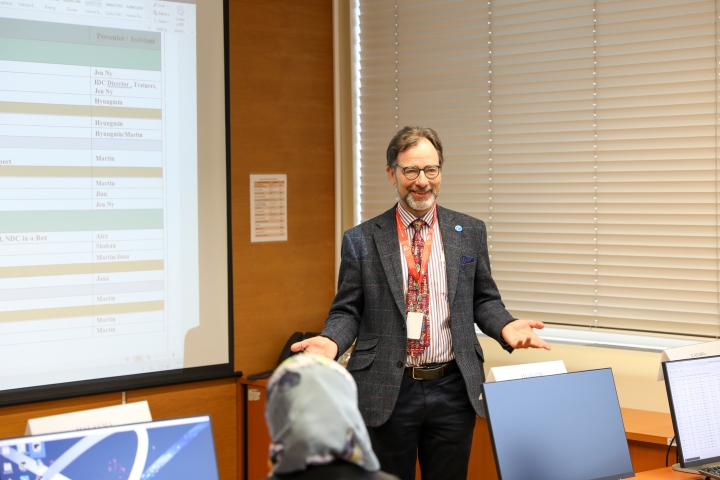
Martin Kalinowski, CTBTO radionuclide expert (IDC), leading session


Participants working with data during training session

Training grounded in real operational practice
The course followed a scenario-based approach, replicating the complete workflow of radionuclide analysis from data access and processing through to final reporting. Participants worked through lifelike cases designed around events relevant to nuclear test monitoring, including simulations of unusual radioactive signatures that could indicate a suspected test.
The exercises were directly linked to data from the International Monitoring System (IMS), the global network of facilities that underpin the CTBT’s verification regime.
Throughout the week, analysts refined essential technical skills such as interactive spectrum analysis review, background correction, isotopic ratio analysis for source characterisation, including location, source type identification, and zero-time estimation. By working with authentic datasets under time-bound conditions, they gained deeper insight into how subtle signals can be separated from normal atmospheric background radionuclides.
Tools, teamwork and alignment with international practice
Participants trained with the same software used at the IDC, including iNSPIRE, RNToolkit and Webgrape. Sessions also covered cross-checking between NDCs and the CTBTO reinforcing best practice in verification analysis and strengthening consistency.
The course was delivered by experts from the Organization, Martin Kalinowski, Jana Meresova, Arend Harms, Robin Schoemaker, Shaban Laban, Alexander Poplavskiy, and Hyungmin Seo, who guided participants through the scenarios and offered individual technical feedback.

Participants listening to speakers during opening session of scenario-based training

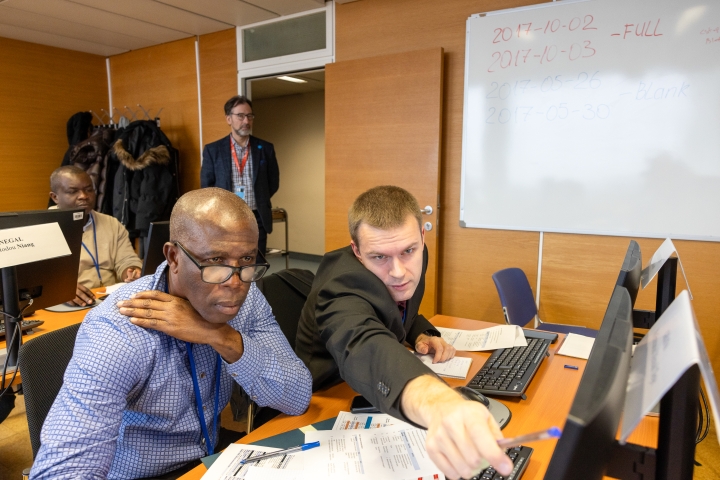
Participants during training session

Cameron Michael Robert Brown, a Radionuclide Analyst at the Atomic Weapons Establishment in the UK, reflected on the experience. “I have enjoyed the chance to learn about the capabilities and the challenges that NDCs around the world face. These challenges are varied and often complex, and many were completely new to me. A common theme among us was the need for better access to training, which highlights how valuable events like this truly are,” he said.
Another participant, Noor Ezati Shuib, a research officer in the Nuclear Safety and Security Group at the Malaysian Nuclear Agency, said, “This was a game-changer for me. The diversity of participants and CTBTO experts really helped me strengthen my particulate spectra analysis with new perspectives while building a network of experts.”
The training forms part of the CTBTO’s wider capacity building programme to strengthen national expertise across the verification regime. By advancing both technical competence and operational confidence, the course contributes directly to the Organization’s global mission to detect nuclear testing and support international peace and security.
11 Dec 2025
FACT BOX: What is a nuclear test explosion?
A nuclear test explosion is the detonation of a nuclear device to measure its performance or demonstrate capability. Unlike conventional explosions, a nuclear test releases distinctive patterns of radioactive material that can spread through the atmosphere, leaving behind signals that can be detected thousands of kilometres away.

Dounia Keda, International Data Centre (IDC) Division Director speaking at opening of training

FACT BOX: What are radioactive particles?
Particle-bound radionuclides are tiny traces of material released during nuclear activities such as a test explosion. Carried by the wind and often invisible, these particles can travel far from their source and reveal important clues about where an event occurred and what type of source was involved.
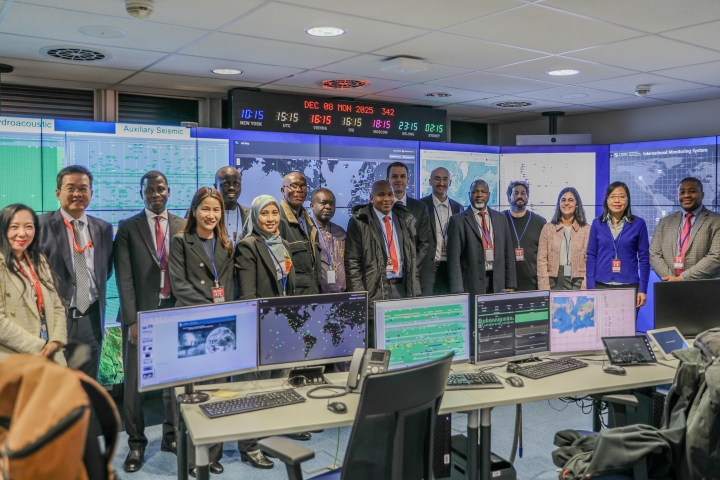
Group photo of participants and CTBTO staff at IDC Operations Centre

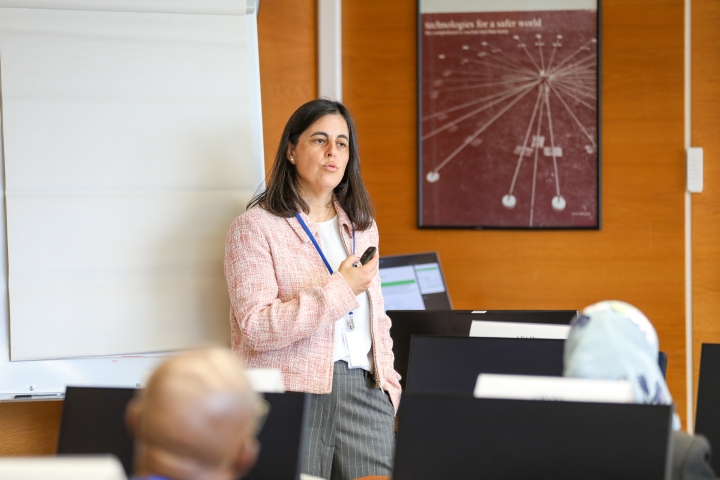
Begoña Pérez López, principal scientist from Spanish NDC presenting during training

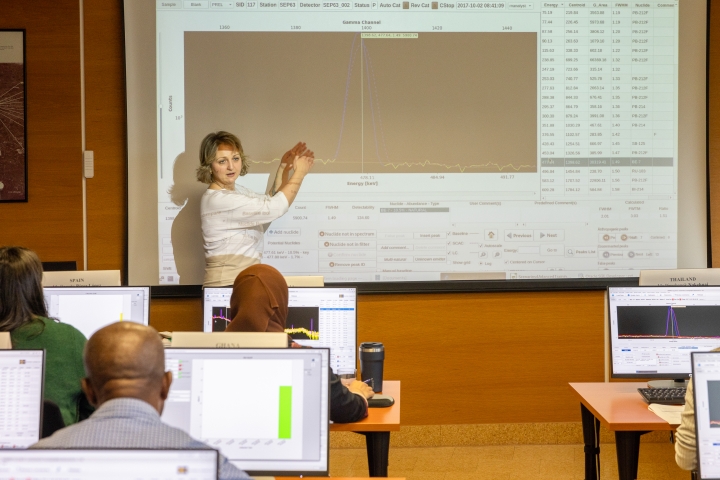
Jana Meresova, associate analyst specialising in radionuclide science at CTBTO, leading session