

In March 2014, a cable lying on the floor of the Indian Ocean broke at a distance of 189 kilometres from shore. This cable, lying on the seabed more than a kilometre and a half beneath the surface, carried the signal from one of the most remote listening posts of the Comprehensive Nuclear-Test-Ban Treaty Organization (CTBTO), back to land. The station is called HA08, built from two parts, North and South. South kept listening, as it had done since 2000, with its cable intact. North went silent and stayed silent for 12 years.
HA08 North is part of a hydroacoustic station in the International Monitoring System (IMS), which listens, worldwide and without pause, for signs of nuclear weapon test explosions. Sound travels more efficiently through water than through air, and the sea holds a layer, the SOFAR channel, where it can carry for thousands of kilometres with minimal loss. HA08 North's sensors sit inside that layer, 1,200 metres down below the sea surface, off Diego Garcia in the Chagos Archipelago. Three underwater sensors, called hydrophones, form a triangle roughly two kilometres wide. The difference in arrival time between them, sound reaching one before the others, tells the station not just that something happened, but where it came from.
The sensors sit at the end of a cable running some 215 kilometres to shore, where the signal is picked up and sent on to the International Data Centre (IDC) in Vienna. When the cable broke, the power went with it, and HA08 North stopped. It hadn’t failed. It had just gone dark.
A break 189 kilometres from shore
Repairing a cable at that depth is not just a matter of sending down a diver. It takes a specialised cable ship, loaded in Singapore, then sailed via Sri Lanka to the repair site off Diego Garcia. Its task, once there, was to find a cable it could not see, somewhere on a seafloor almost two kilometres down, and bring it to the surface intact.
The tool for that is a cut-and-hold grapnel: an anchor built to grab the cable from below, sever it, and hold the end that needs recovering. The ship held position above the seabed while the grapnel worked, using dynamic positioning to counter the waves and currents. It is precise work, done blind, at a depth and pressure most engineering never has to reckon with.
Both grapples performed on this mission, one on either side of the break, succeeded on the first attempt. That is not the norm. It was possible thanks to a detailed seafloor map, and to a ship's crew with long experience in cable repair at sea.
Cable-laying vessel CS Teneo
A triangle of hydrophones, deep enough to hear across an ocean
The first cable end that the team brought up was the one running towards the triplet. Before anything else, they connected it to a test setup in the ship's laboratory, to find out whether the hydrophones, silent for 12 years, would still respond.
Whether the triplet had survived over a decade in the deep ocean was a question only this moment could answer.
It answered. The signal came back, and the data was good.
That single test told the team the triplet was alive, and that the cable between ship and triplet was sound. It confirmed what months of studies, analyses and risk assessments had suggested: that the triplet stood a real chance of still working. The rest of the mission had a purpose. The team lowered the cable end carefully back to the seafloor and moved to the second grapple point, closer to shore, to recover and test the other side of the break.
Repairing a subsea cable no one had touched in 12 years
With both ends recovered, the team turned to jointing: splicing new, better-armoured cable into the gap left by the break. Technicians travelled with the ship for this alone. Their work meant mating fibres barely thicker than a human hair, then sealing the joint to withstand seawater pressure at two kilometres' depth for decades to come.
The first joint was made on the shoreward side. The ship then laid new cable along a precisely planned route, back towards where the seaward cable had been left. There, the two ends were joined a second time, and the repaired cable was lowered to the seafloor for the last time.
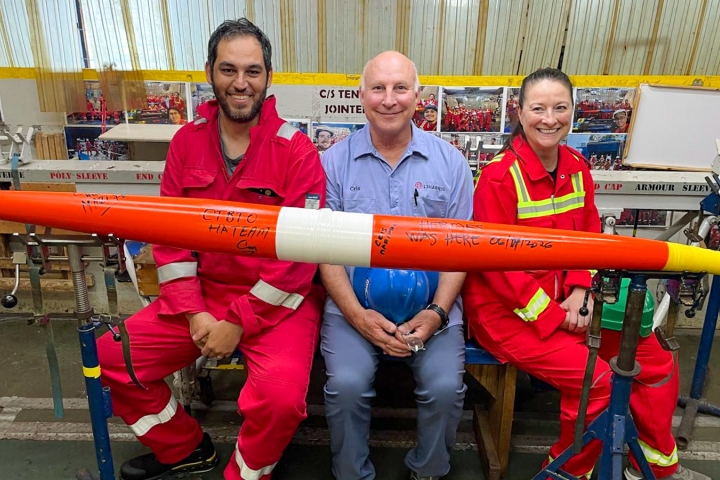
Final cable joint, CTBTO and contractor representatives onboard CS Teneo

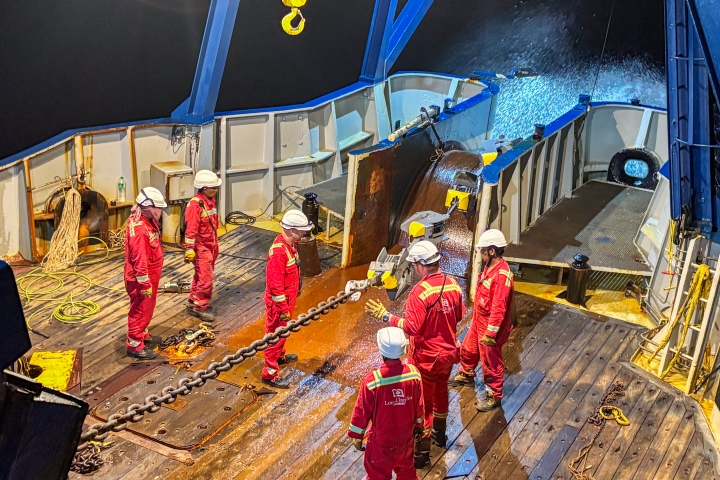
Seaward-side subsea cable recovered onboard using cut-and-hold grapnel

A joint that has to survive two kilometres down, for decades
None of this happened at sea alone. A shore team on Diego Garcia had spent days beforehand testing the shore end of the cable and rehearsing with artificial data fed into the station computers, so the station would be ready the moment the connection returned.
“Everyone came prepared. The critical steps, on the ship, at the shore station, and in the IDC, had been rehearsed several times before the repair operations began. The goal was not perfection. It was no surprises.”
Through the entire repair operation, they stayed in constant contact with the ship and with colleagues at the IDC and IMS Divisions in Vienna, who checked incoming data in real time, often deep into the night. It was a joint effort in seamless coordination between experts at sea, on the island, and at screens thousands of kilometres away, made possible by satellite communications that would have been unthinkable a decade ago.
The moment the data came back
On 17 June 2026, the shore team began receiving signals from the HA08 North triplet for the first time since 2014. Data began arriving in Vienna within minutes.
For a team that had spent years planning this and weeks executing it, the moment carried real weight. Some spoke of the pressure and precision the work demanded day after day on open water. Others remembered something quieter: that whatever the conditions, the stars at night always showed the way.
“Over the course of two nights, when we checked the data for the first time and saw earthquakes and whale songs, we realised that project risks we had studied and mitigated over many years simply went away. And we knew we had done the right thing.”
“Seeing the first data come through onboard the vessel was a moment of pure joy. We knew, right there, that we had done it.”
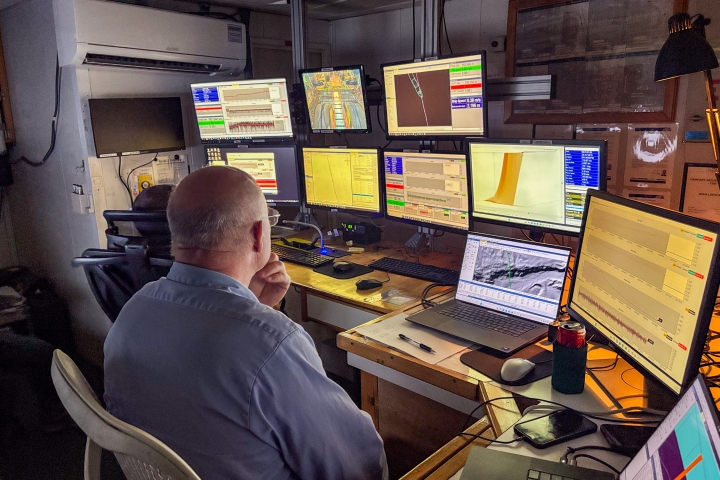
Precision cable-laying operation at control station on bridge

The station ran under test for eight hours before the team stood down.
HA08 North was, once again, on its own.
Every light on the board is now green
This repair matters beyond one station fully coming back online. HA08, with its North and South triplets, was installed and certified in 2000, making it the oldest hydroacoustic station in the IMS. South never stopped working. North's recovery shows that a station this age can be brought back from a serious subsea failure without the cost of a full rebuild. It makes the case for repair and sustainment over replacement, provided the resources are there when they are needed.
They were, this time, thanks to the United States and the United Kingdom, with additional support from Denmark, Finland, Israel and Slovakia, and to the work of technical teams from the station operators, the contractors and the CTBTO, at sea and on shore, over more than a month of travel, testing and repair.
With HA08 North restored, coverage of the northern and western Indian Ocean, one of the world's great acoustic corridors, is whole again.
It also completed something larger. All 11 stations in the hydroacoustic network are now fully operational, the first IMS technology to reach that mark in full.
For 12 years, a station built to guard the world's silence sat in the dark. Now it is listening again.