

Peru becomes 22nd country to sign CTBTO tsunami warning agreement
Peru held a ceremony on 5 December 2025 to sign an agreement with the Comprehensive Nuclear-Test-Ban Treaty Organization (CTBTO) to strengthen national tsunami preparedness. The event in Lima was attended by CTBTO Executive Secretary Robert Floyd, Luis Felipe Ugarelli Basurto, Director General for Multilateral and Global Affairs at the Ministry of Foreign Affairs of Peru, and Eric Anderson Machado, Secretary General of the Ministry of Foreign Affairs of Peru.
The agreement will give the country access to essential seismic and hydroacoustic data for tsunami early warning.
Through this agreement, Peru’s Centro Nacional de Alerta de Tsunamis (CNAT), operated by the Directorate of Hydrography and Navigation of the Peruvian Navy, becomes the 23rd centre globally to formalise such an arrangement with the CTBTO. CNAT is already recognised by UNESCO’s Intergovernmental Oceanographic Commission (IOC) as the country’s official tsunami warning authority.
“This partnership will support national authorities in Peru as they strengthen their tsunami early warning efforts. It shows how working together through the CTBT framework can help keep communities safe, while maintaining a clear focus on our core mission of monitoring for nuclear tests.”
Ugarelli Basurto welcomed the agreement.
“This reflects Peru’s firm commitment to safeguarding its population and to deepening international scientific cooperation in support of disaster risk management.”
The CTBTO’s International Monitoring System (IMS) is a global network comprising more than 300 facilities, including over 160 seismic and hydroacoustic stations. While its primary function is to detect nuclear weapon test explosions, the network’s data is made available to tsunami warning centres recognised by UNESCO. This initiative followed the devastating 2004 Indian Ocean tsunami and has since helped build national capacities across vulnerable regions.
Peru’s Pacific coastline lies along the seismically active Pacific Ring of Fire, leaving it naturally exposed to tsunami risk. The 2007 Pisco earthquake generated a tsunami that was modest in many recorded measurements, yet it highlighted how challenging it can be to deliver timely warnings to every community, particularly along remote stretches of coast. More than two centuries earlier, the catastrophic 1746 Lima-Callao tsunami destroyed the country’s main port and took thousands of lives, an event that continues to shape national awareness of tsunami hazards.
This latest agreement follows the CTBTO’s most recent regional partnership with Cuba in September 2025 and marks another step in expanding tsunami early warning capabilities across the Latin America and the Caribbean (LAC) region.
4 Dec 2025
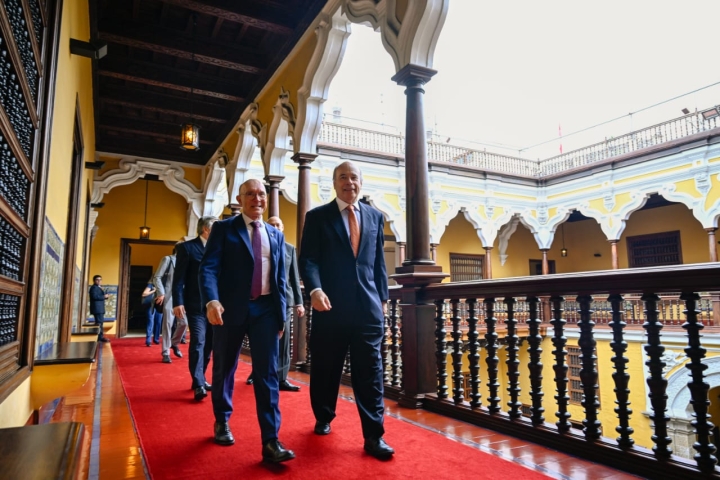
Executive Secretary Robert Floyd walking with Secretary General of Peru's Ministry of Foreign Affairs, Eric Anderson Machado,


Tsunami warning agreement signing ceremony. From left to right: Floyd, Anderson Machado and Luis Felipe Ugarelli Basurto, Director General for Multilateral and Global Affairs, Ministry of Foreign Affairs of Peru
